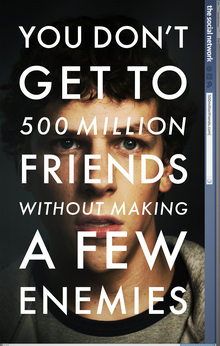
The Social Network is an Academy Award winning movie that tells the story of the creation of Facebook. The movie begins with Mark Zuckerberg (played by Jesse Eisenberg), a Harvard undergrad that goes on a furious rampage of blogging and programming because of a recent breakup. That night, he creates the idea that would make him the youngest billionaire in six years’ time. The movie was released in 2010 and is directed by David Fincher. The Social Network successfully employs immaculate screenwriting, a hefty music score, and entrancing editing that its audience will never forget.
The Social Network is told through flashbacks, as Zuckerberg is in the middle of two different lawsuits during the movie. The film opens at a college bar in which Mark Zuckerberg and his girlfriend, Erica Albright, are talking and having a few beers. The two get into a conversation about final clubs, and it is obvious that Mark is eager to join one. Erica lets it be known that she thinks Mark is “obsessed” with final clubs. The two get into an argument because Mark is convinced that Erica is not confident about him being able to get initiated. Erica ends their relationship at the bar, and Mark anxiously runs back to his dorm room. There, he begins angrily blogging about the breakup. Moments later, Mark’s roommate, Billy Olson, proposes the idea that Mark make a website that compares female Harvard undergraduates to pictures of farm animals. Mark then begins hacking into the halls’ information systems to access the girls’ pictures and blogs simultaneously. After the incident, the Winklevoss twins approach Zuckerberg, eager for his assistance on a new idea for a project called Harvard Connection, a social media site exclusive to students at Harvard University. After being approached, Zuckerberg begins to avoid the twins while he works on his own social media project with Eduardo Saverin. The site begins to spread from campus to campus across the United States, and the “Winklevi” (what Mark refers to the pair as) notice that Zuckerberg is the founder. The two (and partner Divya Narendra) sue Mark for theft of their idea. As the site begins to grow more and more, Zuckerberg and Saverin begin to debate whether monetization should be added to the site. Sean Parker comes along and sides with Zuckerberg, agreeing that the site is “cool,” and that monetization is not yet needed. New investors come along while Saverin is on internship in New York. He ends up losing his place in the company and sues Zuckerberg for it. That brings the viewer to the current place in the movie, in which Zuckerberg is in the middle of two different lawsuits.
The Social Network Official Trailer
The overall tone of the film is suspenseful. Visually, the movie is portrayed with dark filters that drape over the characters and scenery. The characters’ shadows are much more evident, creating a darker feel to the movie itself. There is also rapid transition from scene to scene, a probable reason that the film won an Academy Award for its editing. Auditorily, the screenwriting makes for a scholarly dialect that is not at first grasped by the average movie viewer. The music is deep and appropriate for the events at hand. Put together, the movie effectively utilizes visual and auditory components to make for a cinematic experience that viewers will never forget.
The movie specializes in its screenwriting. Like mentioned, there are many quotes that the average viewer will not understand at first. Throughout the film, there is an overwhelming amount of absurd analogies and complex technological references that are made. From Zuckerberg’s high-speed dialect to Saverin’s complex business vocabulary, certain quotes naturally go over the viewer’s head. Written by Aaron Sorkin, The Social Network’s screenwriting verbally brings each character to life.
The infamous hacking scene that brings Sorkin’s screenwriting to life
The music is heavy. From classic “riffy” guitars to deep bass tones, the music score makes for an effective component of The Social Network. Developed by Trent Reznor and Atticus Ross, the music selected for the movie plays an adequate role on the film’s effect on the viewer’s experience. The music naturally corresponds with the events at hand, simultaneously climbing to severe fortissimos when the film hits its most critical points. The Social Network’s music score has a critical effect on the way that the movie is received by the viewer.
The Social Network’s editing won an Academy Award simply for its effective transitioning abilities. Using Final Cut Pro, Angus Wall and Kirk Baxter work together to edit the film in such a way that keeps the viewer in the present (during the lawsuit scenes), yet simultaneously brings the viewer back to the humble beginnings of Facebook at Harvard University and Palo Alto, California. This editing style is crucial to the way that the movie is received by the viewer, as he/she is transported from the lawsuits that display Zuckerberg’s corruption to the beginnings of the most popular social network in the world.
An excellent scene that displays how the music works with the transitions
David Edelstein of New York Movies writes that:
“Eisenberg has been, until now, a hugely likable actor with an instinct for thinking and fumbling in character. As Zuckerberg, he’s been whipped into monotony. Fincher directs like a drill sergeant—Mamet with an overwound metronome.”
It seems that Edelstein believes that Zuckerberg should not be played as a monotonous nerd, that Fincher failed by characterizing the billionaire in such a way. Eisenberg’s portrayal of Zuckerberg is spot-on, as the real founder of Facebook displays himself in the same way that Eisenberg does in The Social Network. Put simply, he is an unathletic computer geek that cares nothing about fashion and has a quick way with words. Eisenberg accurately depicts Mark Zuckerberg in this film.
Another critic, Jeff Jarvis of buzzmachine.com, believes that:
“There’s no “why” there. That’s the problem with The Social Network. It neither explains nor even ascribes motives to Mark Zuckerberg—no vision, no strategy, no goals.”
This critic is ignorant to the film’s purpose. Facemash, the site preceding Facebook, was made for two reasons. One being that Zuckerberg wanted attention from final clubs, that he had to do something “substantial” to get their attention. On the other hand, the triggering variable is Mark’s ex-girlfriend. Erica Albright is a huge motivator for Zuckerberg’s drive to make Facebook the world’s most popular social network. There is a scene in-particular in which Mark approaches his ex-girlfriend at a pub. She does not accept his offer to talk to him in private and embarrasses him in front of all of her friends, just as he did to her. As Mark foolishly walks away from the table, he anxiously whispers to Eduardo: “We need to expand.” In the following scene, Zuckerberg tells his team that the site will be going live at Yale and Columbia. It is evident that Albright is a reason for Zuckerberg’s success. In this scene, though, Saverin elects that the site should go live at Stanford University. In his own words: “It’s time for them to see this in Palo Alto.” Having Zuckerberg get on board with this idea produces investments of immense wealth, a strategy that immensely affects the reason that the company is worth what it is today.
Paul Asay of pluggedin.com claims that:
“Amiable and winsome, Eduardo is Mark’s only true friend. As the rest of Harvard ignores Mark, Eduardo supports him, both personally and—as The Facebook slowly takes flight—financially. He ponies up the first $1,000 for the venture, becoming Facebook’s chief financial officer, then sweetens the pot to $19,000 when Mark sets up shop in Palo Alto, Calif. He’s not the film’s hero, but its everyman. And it’s through Eduardo’s eyes that we see Facebook’s brilliant and brutal beginnings. He is, in some respects, a Horatio Alger character … ultimately betrayed by the American Way. He works hard and plays by the rules, only to find that the rules have changed around him.”
This is a brilliant description of Eduardo. It is evident that he does everything the way they should be done just to get thrown under the bus at the end of the film. Mark let go of his only true friend in college. Eduardo cared for him. It is debated whether not it was Mark’s plan to get him out of the company, but regardless, that is what ended up happening in the end of the film.

Like previously mentioned, The Social Network is a must-see film. The film is award-winning because of its screenwriting, music score, and editing. The movie’s screenwriting brings its characters to life through verbal dialogue that will never be forgotten by the viewer. The complex analogies and loaded technological language used makes for an intellectual film that viewers rave about. Developed by heavy overtones that enter and exit throughout the movie, The Social Network’s music score is crucial to the way that the film is received by its audience. The music effectively climaxes at crucial points during the movie in which it has the viewer’s full attention. The editing is also crucial to the way that the film is received. Transitioning from modern-day lawsuits to the beginnings of Facebook, the editing style is essential to the overall point of the movie. One should see The Social Network if he/she has the chance.


 Grover Movie Reviews